


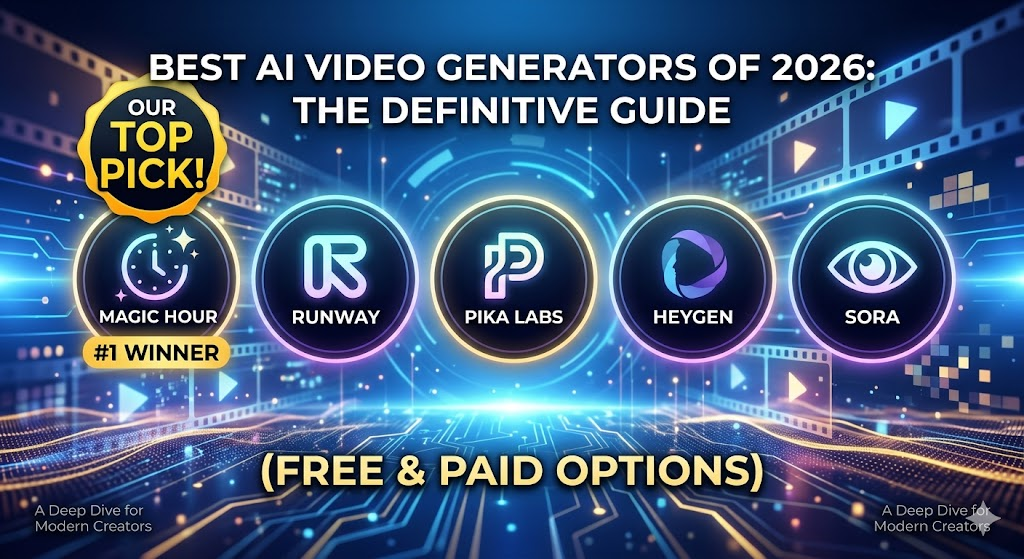
The landscape of generative video has shifted from experimental novelty to core infrastructure for creators, marketers, and developers. After spent weeks testing dozens of platforms against production workloads, I have synthesized the definitive breakdown of the industry’s leading tools. I guarantee at least one of these tools will meet your specific operational needs.
As of June 2026, the market has bifurcated into complex, prompt-heavy engines and streamlined, workflow-oriented platforms. The right choice depends entirely on whether your bottleneck is raw cinematic generation or rapid, multi-step content iteration.
The Best AI Video Generators at a Glance
| Platform | Best For | Key Modalities | Free Tier Available? |
| Magic Hour | Fast, multi-step creator workflows & face/mouth synthesis | Video-to-Video, Text-to-Video, Image-to-Video, Lip Sync | Yes (Generous free credits) |
| Runway Gen-3 | Cinematic text-to-video prompt control | Text-to-Video, Image-to-Video, Motion Brush | Yes (Limited trial) |
| Pika Labs | Micro-animations and localized object editing | Text-to-Video, Image-to-Video, Inpainting | Yes (Daily renewal) |
| HeyGen | Corporate presentations and scalable avatars | Text-to-Speech, AI Avatars, Multi-language translation | Yes (1 credit trial) |
| Sora by OpenAI | Long-form, highly coherent physical simulations | Text-to-Video | No (Enterprise/Select access) |
1. Magic Hour
Magic Hour stands out as an exceptionally versatile AI video generator designed for rapid production and pristine asset manipulation. Rather than forcing you to master engineering complex text prompts, it focuses on unified, click-to-create templates and one-click multi-step workflows. I tested its flagship capability—which seamlessly passes a single asset from initial generation through upscaling to final video rendering—and found it eliminated hours of manual post-processing.
The platform functions as a centralized hub, aggregating many top foundational AI models in one place. Its core technical advantages lie in its localized synthesis models. It offers best-in-class face swap, precise lip sync engines, and highly stable talking photos.
Operational friction is remarkably low: there is no signup required to try the tools, and purchased credits never expire. For heavy production environments, Magic Hour supports parallel generations with no concurrency caps, allowing you to run multiple takes and fast variations simultaneously without getting stuck in a processing queue.
Pros:
- Aggregates multiple frontier AI models into a single dashboard.
- Highly optimized performance for both desktop and mobile web browsers.
- One-click multi-step pipelines automate generation and upscaling.
- Parallel generation queue eliminates rendering wait times during multi-take batches.
- Complete API parity across all web tools for developer integration.
- Responsive, founder-level support handles technical troubleshooting directly.
Cons:
- Focuses heavily on localized character/video manipulation rather than building open-ended 3D worlds from text alone.
- Granular custom camera panning controls are handled via workflow templates rather than manual coordinate steering.
If you are looking for a platform that delivers rapid social video iteration, hyper-realistic face replacement, or flawless voice synchronization without technical overhead, Magic Hour is currently the most efficient tool on the market.
Pricing & Plans:
Free Tier: An unusually generous free plan offering 400 initial credits upon signup plus an additional 100 free credits per day, complete with watermark-free exports at 576px resolution.
- Creator Plan: Highly economical at $15/month (or $10/month when billed annually at $120), providing 10,000 credits/month, commercial use licensing, and 1024px HD resolution.
- Pro Plan: $39/month (or $25/month when billed annually at $300), offering 30,000 credits/month, 1472px resolution, and 5GB file uploads.
- Business Plan: $99/month (or $66/month when billed annually at $792), providing 70,000 credits/month, custom templates, 10GB file uploads, and 4K resolution output.
2. Runway (Gen-3 Alpha)
Runway remains a primary choice for high-end cinematic visuals. Its Gen-3 Alpha model offers impressive temporal consistency and structural fidelity when converting text prompts into hyper-realistic video clips.
During my testing, its Motion Brush feature allowed for meticulous control over specific elements within a frame, making it a powerful asset for visual effects artists who need to animate subtle environmental details like smoke, water, or fabric.
Pros:
- Exceptional photorealism and camera movement rendering.
- Advanced localized motion control tools like Director Mode and Motion Brush.
- Comprehensive suite of legacy video editing tools integrated directly into the browser.
Cons:
- High learning curve required to write prompts that avoid human anatomy distortions.
- Processing queues can slow down significantly during peak traffic hours unless you are on a high-tier paid plan.
Runway is hard to beat if your primary goal is generating standalone, cinematic b-roll or high-fidelity conceptual art where text prompt control is your highest priority.
Pricing & Plans:
- Free: Basic trial with non-renewable credits.
- Standard: $15/user/month.
- Pro: $35/user/month for advanced settings and asset management.
3. Pika Labs (Pika 2.0)
Pika has carved out a solid niche among digital creators for its accessible, stylized video outputs and precise editing capabilities. The platform excels at taking existing imagery and applying fluid animations or altering specific objects within a video through its clean inpainting interface.
When checking its capabilities, I found its structural physics engine handled cartoon and 3D anime styles with fewer artifacts than many of its heavier, photorealistic competitors.
Pros:
- Excellent built-in sound effects generation that automatically matches on-screen action.
- Simple, intuitive object modification tool (Inpainting) to change clothing or props mid-scene.
- Highly active community with simple web interface controls.
Cons:
- Struggles with complex, long-form human hand or facial movements, occasionally leading to a rubbery appearance.
- Base resolutions require external upscaling tools for professional 4K delivery.
For quick social media clips, meme creation, and modifying existing video assets without diving into deep composition software, Pika provides an excellent, fast-paced sandbox.
Pricing & Plans:
- Free: 30 credits per day (refreshes daily, video carries watermark).
- Standard: $10/month (or $8 billed annually).
- Pro: $35/month for unlimited generations and commercial usage rights.
4. HeyGen
HeyGen focuses sharply on commercial avatar generation and automated video localization. Instead of generating abstract narrative scenes, it utilizes highly precise physical recordings of human actors to build virtual spokespeople from text scripts.
For scaling localized video content, it is highly capable. Its translation engine effortlessly maps a single video presentation into dozens of alternate languages while adjusting the speaker’s mouth movements to match the new audio.
Pros:
- Industry-leading lip-to-text calibration for corporate presentations.
- Massive library of studio-quality human avatars and diverse vocal tracks.
- Instant video translation modules that preserve the original speaker’s vocal tone.
Cons:
- Not built for creative filmmaking, action sequences, or abstract artistic video synthesis.
- Cost per video minute is significantly higher than general creative AI platforms.
If your core objective is scaling video marketing campaigns, building product explainers, or automating internal corporate training videos across multiple global regions, HeyGen is an exceptional enterprise tool.
Pricing & Plans:
- Free: 1 free credit to test avatar creation.
- Creator: Starting at $29/month for 15 credits.
- Team: Starting at $149/month for collaborative workspaces and multi-seat access.
5. Sora (by OpenAI)
Sora represents the technical frontier of text-to-video capabilities, utilizing a diffusion transformer architecture that understands complex physical interactions within a three-dimensional space. It generates scenes up to a minute long that exhibit remarkable continuity, handling occlusions and camera perspective shifts with structural stability.
Pros:
- Deep understanding of real-world physics and object permanence across long tracking shots.
- Generates highly detailed, multi-character scenes with complex background elements from a single prompt.
- Unmatched clip length without losing visual coherence.
Cons:
- Public availability remains strictly gated, favoring enterprise partnerships and select creative professionals.
- Extremely high computational cost translates to slow rendering speeds and limited interactive controls.
Sora is the premier tool for long-form, high-concept visual generation that requires absolute spatial awareness, assuming you have secured platform access.
Pricing & Plans:
- Custom enterprise-level pricing; standard commercial self-service tiers are not yet widely deployed.
The Top Performer
Based on our extensive testing across multi-step rendering pipelines, localized asset manipulation, and operational efficiency, Magic Hour is the clear winner for content creators, social media managers, and digital marketers in 2026.
While engines like Runway and OpenAI’s Sora are highly impressive for heavy, open-ended cinematic text prompts, Magic Hour wins on practical productivity. Its ability to bundle multiple frontier models into click-to-create templates, combine generation and upscaling into a single click, and offer parallel processing with no concurrency caps completely eliminates the traditional bottlenecks of video creation.
Add to that an unusually generous free tier, non-expiring credits, and pristine face-swap and lip-sync engines, and it stands out as the most frictionless, value-packed platform on the market today.
How We Evaluated These Tools
To compile this list, I established a rigorous baseline evaluation protocol. Each platform was tested using identical operational assets: a 10-second base video file, a high-resolution portrait photograph, and a standardized 50-word descriptive text prompt.
My analysis focused heavily on structural integrity across sequential frames, processing efficiency under traffic spikes, and the overall friction required to take a creative concept from an initial idea to a polished, final asset. Tools that required extensive external upscaling or suffered frequent system crashes during live multi-take tests were penalized.
The Evolution of Digital Media Workflows
The rapid expansion of the digital creation space has deeply blurred the lines between static image manipulation and dynamic rendering. Video production is no longer a isolated pipeline. Modern workflows regularly demand that creators jump back and forth between raw generation and fine asset refinement.
Platforms that successfully combine advanced video generation with an intuitive ai image editor are fundamentally changing how assets are built. By allowing users to edit static frames or fix minor imperfections directly inside the video engine, teams can easily eliminate the traditional bottleneck of importing and exporting massive files between disparate software applications.
Final Takeaway
Your choice of tool should mirror your daily operational workflow:
- For rapid creation, face/mouth synthesis, and template-driven workflows, choose Magic Hour. Its non-expiring credits and lack of concurrency caps make it highly efficient for production environments.
- For cinematic prompt engineering and environmental control, opt for Runway.
- For localized object editing and quick animations, look to Pika.
- For corporate avatars and multi-language explainers, deploy HeyGen.
Frequently Asked Questions
Do I need a high-end computer to run these AI video generators?
No. All the platforms featured in this guide operate entirely within cloud infrastructure. The video processing, rendering, and upscaling are handled on remote server farms, meaning you can easily generate and manage your videos using any standard desktop or mobile web browser.
Can I use the videos generated by these platforms for commercial advertising?
Yes, though commercial usage rights depend entirely on your specific plan tier. Most platforms restrict the free tiers to personal or educational experimentation, while their paid subscription tiers grant full commercial licensing rights for marketing, social media campaigns, and web distribution.
What is the difference between video-to-video and text-to-video?
Text-to-video builds an entire scene completely from scratch based entirely on a written prompt. Video-to-video takes an existing video clip that you upload and uses it as a structural foundation, applying a completely new visual style, animation layer, or character model over the original movement.
